

Tank collection, milk evidence and release
What this page helps you do
Section titled “What this page helps you do”Tank collection connects animal milk records with collected, withheld and dispatched quantities. Use its safety and evidence controls to explain where the milk went and why a lot may be blocked.
Three quantities answer different questions:
| Record | Question it answers |
|---|---|
| Animal milk recording | How much did this animal produce in this milking? |
| Session collection | How much did this session put into the tank? |
| Buyer delivery | How much was dispatched or collected for the buyer? |
Do not enter the tank’s accumulated level as each session’s collection. For example, if there were 500 L in the tank and this session added 400 L, the session collection is 400 L, not 900 L. A buyer delivery of 900 L is recorded separately.
Record a session collection
Section titled “Record a session collection”Open Milk → Record → Record Session Collection.
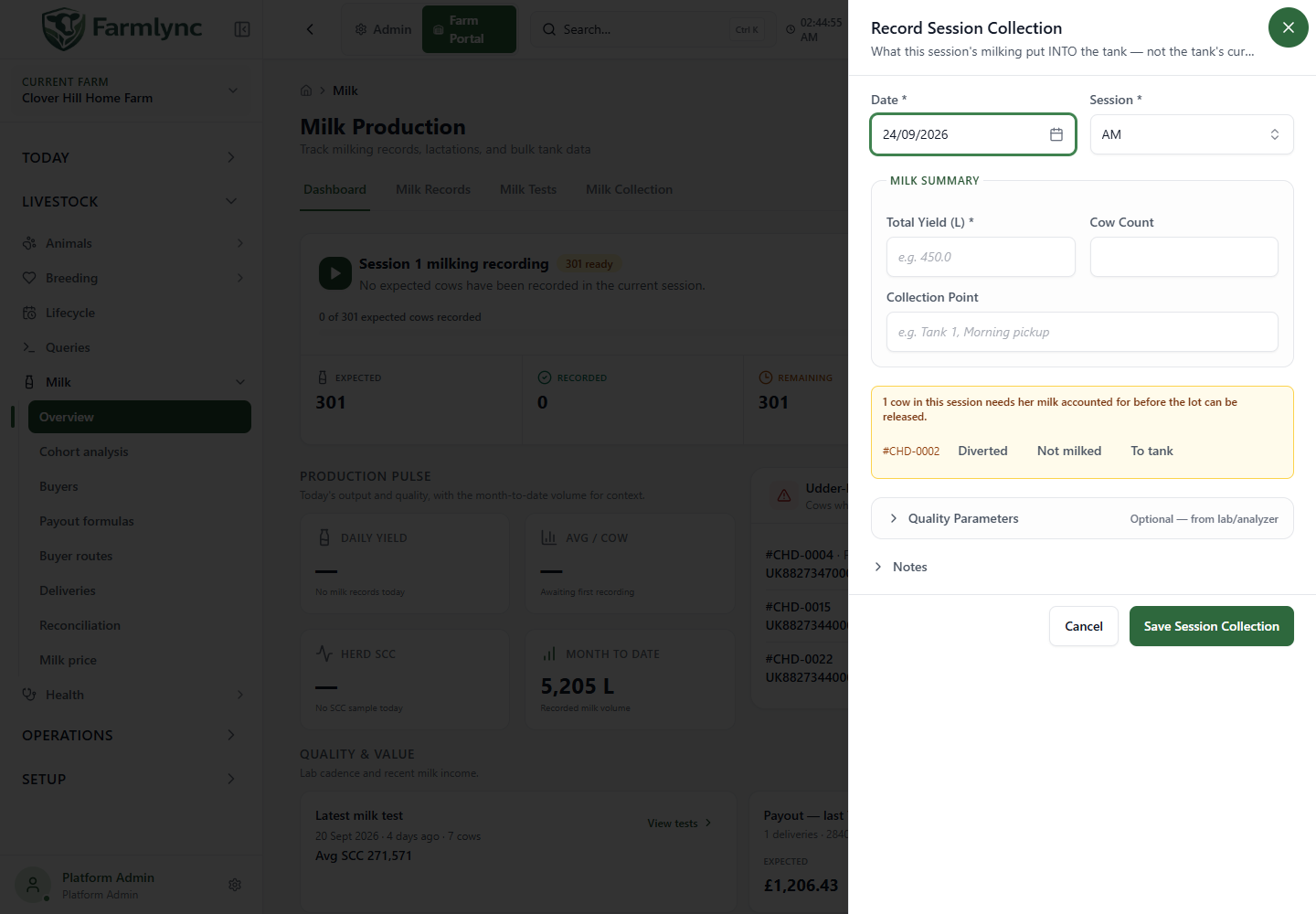
| Field or control | Input and purpose |
|---|---|
| Date * | The farm-local date of the completed session. Starts with today. The current form and command do not block a future date, but a future collection would be treated as recorded stock and can affect safety and delivery evidence. Enter only a session that has actually happened. |
| Session * | Select the actual session: AM, PM, Night, Session 4 or Session 5. Use the session operated on this farm. |
| Total Yield (kg/L) * | The amount this session put into the tank, in the displayed unit. The form requires at least 0.1. It can fill from the session’s recorded saleable milk; replace it with the correct measured collection where necessary. |
| Cow Count | Optional positive whole number. Can fill from the session records. A note compares your count with the recorded animal count. |
| Collection Point | Optional text, up to 100 characters; for example the tank or collection location. This is not a buyer delivery. |
| Quality Parameters | Expand to enter measured laboratory/analyser values. Leave unknown results blank. |
| Notes | Expand to record relevant context. Keep notes concise and factual. The form allows up to 2,000 characters. |
| Save Session Collection | Save the collection and run the server’s safety evaluation. A saved collection may still be held for review or quarantined. |
| Cancel | Discard unsaved collection fields. Milk-evidence actions saved separately within the panel are not undone. |
Only one session collection can occupy a farm/date/session. If one already exists, review that record instead of creating another.
When changing Date or Session, wait for the corresponding summary and review the quantity and cow count again. A positive saleable summary can replace the form’s suggested values. If the new session has no positive saleable total, check that a previously entered quantity is not still in the box.
Quality field limits
Section titled “Quality field limits”| Field | Accepted value in this form |
|---|---|
| Fat % | 1–9 |
| Protein % | 1–6 |
| Lactose % | 2–6 |
| SNF % | 5–12 |
| SCC (cells/mL) | Positive whole number, entered in cells/mL. |
| Temperature (°C) | 0–50 |
These are collection-level measurements. They do not become individual cow test results.
Read the reconciliation panel
Section titled “Read the reconciliation panel”Where the session has recorded saleable production, the form compares it with the entered collection:
- Saleable total comes from the animal milk allocations for the selected session.
- Collection total is the quantity currently entered in this form.
- Difference is collection minus saleable total, with the percentage calculated against the saleable total.
The form colours this comparison green within ±5%, amber above 5% through 15%, and red above 15%. These colours are input-review hints. They are not the server’s delivery-clearance tolerance. Verification currently uses the larger of 2 kg or 2% of expected saleable milk, as well as the safety checks below.
For example, expected saleable milk of 1,000 kg has a verification tolerance of 20 kg. A 1,040 kg collection can appear within the form’s 5% band yet still be outside the server’s verification tolerance.
Use the expandable animal breakdown to inspect contributors; it is paged in groups of 100. Investigate a difference through the actual milk records, diversions, spillages or measurement evidence. Do not change the total solely to obtain a green indication.
Held milk is shown separately from saleable milk. If some production has not been allocated, the displayed saleable total is provisional: the collection can be recorded, but incomplete allocation prevents verification for dispatch.
Account for where each cow’s milk went
Section titled “Account for where each cow’s milk went”The Milk disposition evidence section lists animals whose milk needs an explanation before the lot can clear. “Disposition” means where the milk physically went, rather than how a quantity was later classified in a report.
| Action | What you are asserting |
|---|---|
| Diverted | All milk from that animal in this session was kept out of the saleable tank. This records the destination fact; it is not advice about a permitted alternative use. |
| Not milked | The animal was not milked in this session. An absent record alone is not proof of this. |
| To tank | At least some milk from that animal in this session entered the saleable tank. |
Selecting one of these buttons saves evidence immediately. It does not wait for Save Session Collection. Read the animal and session before selecting it, and use only the statement supported by what actually happened.
The system retains claims on file. Selecting a different statement later does not silently replace the first; contradictory evidence blocks clearance and must be reconciled. A “Not milked” claim conflicts with a positive milk record for the same animal and session.
Correct contradictory evidence
Section titled “Correct contradictory evidence”An authorised owner or manager can use Resolve evidence… where a conflict is shown:
- Read the claims and conflict reasons.
- Correct an incorrect underlying milk record first where necessary. For example, do not assert Not milked while retaining a genuine positive recording for that session.
- Choose Corrected milk disposition.
- Enter Evidence and reason for correction, required and up to 500 characters.
- Select Save audited correction.
Your identity and explanation are retained with the replaced claims. This action reconciles evidence; it does not itself release a held tank lot or close a linked delivery incident. If the evidence changed while the form was open, refresh and review the current facts before trying again.
Check the collection’s status
Section titled “Check the collection’s status”Return to Milk Collection and inspect its verification badge and available actions.
| Status | Meaning |
|---|---|
| Not checked | The collection has not yet been verified against its contributing milk. |
| Verified | The quantity and available safety evidence passed the application’s verification at that time. |
| Needs review | Evidence, allocations or quantity reconciliation need attention. This status is not itself a confirmed contamination finding. |
| Quarantined | The lot is held and must not be delivered until an authorised release succeeds. |
| Disposed | The lot has been discarded. This is terminal; normal verification cannot restore it to deliverable milk. |
Hover over the badge where details are available to see accounted-for quantity, variance and tolerance. Verify this collection or Re-check this collection requests a fresh server check. It does not simply switch the badge to Verified.
The check considers saleable allocations and evidence for the session’s relevant cows, including a cow whose withdrawal matters even when her yield has not been recorded. Missing destination evidence can hold a session. Evidence of withdrawn milk entering the tank can quarantine it.
Later records can change a previously acceptable result. For example, a late treatment entry covering an earlier milking can cause the related collection and deliveries to require review. Always inspect current status before dispatch.
Audited release of a held lot
Section titled “Audited release of a held lot”The release action requires milk-correction authority, normally an owner or manager. It is available only for a qualifying held session collection or a qualifying verified lot with open delivery incidents.
| Field or button | Meaning |
|---|---|
| Reason for release * | Explain what was corrected and why reassessment is justified. 10–500 characters. |
| Supporting evidence * | An identifiable factual reference, such as the relevant corrected record or laboratory evidence. 5–1,000 characters. |
| Keep quarantined | Close without releasing the lot. |
| Re-verify and release | Ask the server to re-evaluate current evidence and quantities, then release only if its conditions are satisfied. |
Release is refused while relevant withdrawal exposure remains confirmed or unresolved, allocations are incomplete or require further review, or the quantity remains outside tolerance. A stale version also requires reopening the lot. Entering an explanation does not override those checks.
After success, read the notification about linked deliveries. Releasing one lot does not imply every related delivery is clear if another blocking condition remains. Recorded release evidence is retained for traceability.
Record an opening balance only when needed
Section titled “Record an opening balance only when needed”Use Milk → Record → Record Opening Balance for milk already in the tank when per-cow tracking begins. It is a one-off starting lot, not another way to record a daily session or bypass a held collection.
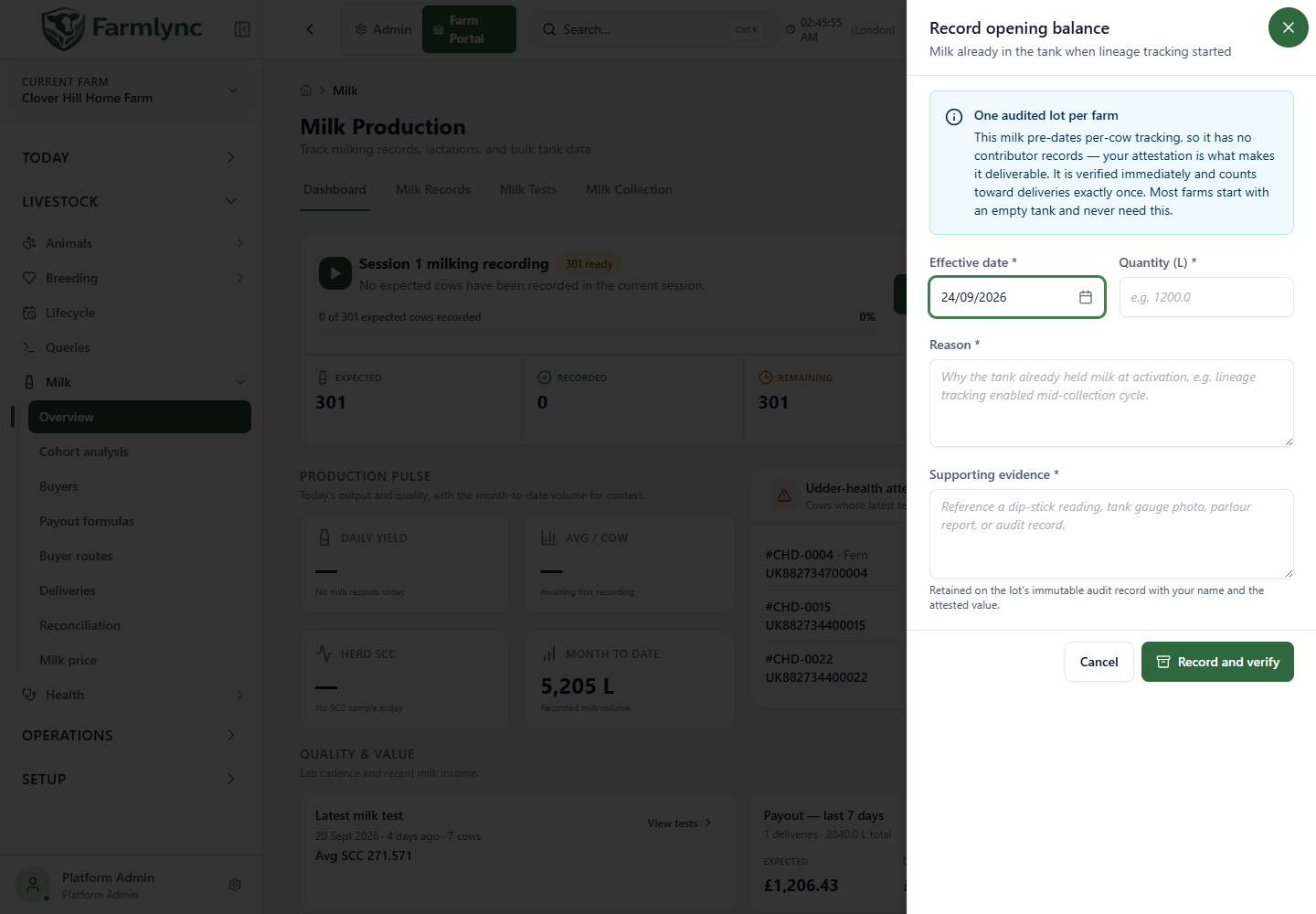
| Field | Required input |
|---|---|
| Effective date * | The farm-local date represented by the opening stock. |
| Quantity (kg/L) * | Positive attested quantity in the displayed unit. The server’s raw-input upper guard is 50,000. |
| Reason * | Why this opening milk exists; 10–500 characters. |
| Supporting evidence * | An identifiable reference to the measured stock, such as a tank-gauge record; 5–1,000 characters. |
| Record and verify | Save and verify the opening lot in one audited action. |
Only a named user with the required owner/manager-level permission can perform this action. An opening lot has no per-animal contributor records, so the user’s attestation and evidence are important. It is verified at creation and counted once toward deliverable stock. The farm cannot create a second opening lot alongside the existing one; inspect the original if a correction is required.
Most farms that begin tracking with an empty tank do not need an opening balance.
To correct an editable collection’s amount or quality values, or to enter official cow test-day results, see Edit a session collection and record milk tests. The Diverted, Not milked and To tank decisions above are the milk destination evidence used by the safety check; they are not ordinary edit fields.
A practical check before delivery
Section titled “A practical check before delivery”- Confirm animal records and the measured session collection refer to the same date and session.
- Account for withheld milk using the actual destination evidence.
- Correct conflicts or missing allocations through their appropriate controls.
- Review the lot’s current status and use verification or audited release where applicable.
- Record the buyer delivery separately. Do not assume the collection-save notification means a delivery has been created or cleared.