

Semen Stock
What this page helps you do
Section titled “What this page helps you do”Operations → Inventory → Semen Stock connects a sire’s breeding identity with separately counted straw batches. Use it before a stock-controlled insemination so the intended sire and available straws are recorded accurately. Semen Stock uses its own breeding stock model; general medicines and feed are in Animal Health and Feed Stock.
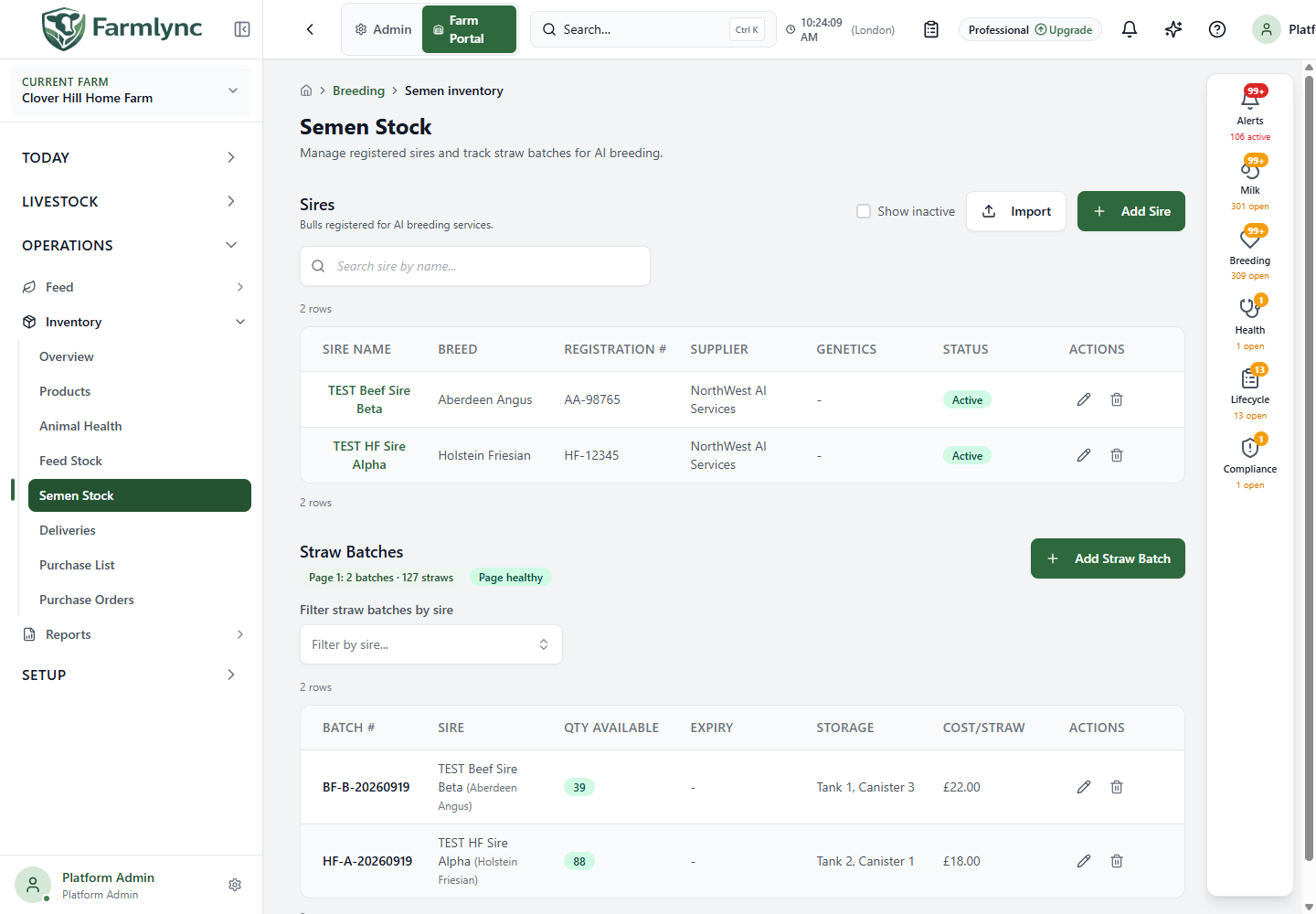
The page has two related registers:
- Sires stores the breeding identity, registration and genetic information used when recording an AI service.
- Straw Batches stores the physical units available for each sire, including the batch, type, location, expiry and cost.
Adding a sire does not add stock. Adding a batch does not record a breeding service. When a service is recorded against a controlled straw batch, Farmlync can deduct the used straw and preserve a movement against that breeding record. Creating, importing, editing or deleting semen records requires the breeding-record permission used by Owners, Managers and Vets. Support read-only sessions can inspect the page but cannot use its write actions.
Find a sire or batch
Section titled “Find a sire or batch”The sire table shows 20 entries per page. Search by sire name; the search waits briefly while you type before reloading the list. Leave Show inactive clear for active sires only, or select it to include inactive entries. The columns show sire name, breed, registration number, supplier, genetic merit or AI code, and active status.
Select a sire’s name to filter Straw Batches to that sire. The separate sire filter above the batch table provides the same choice and can be cleared to restore the whole-farm batch list. The batch table shows 50 entries per page with:
| Column | Meaning |
|---|---|
| Batch # | Supplier or collection batch identifier. The semen-type badge appears beside it when recorded. |
| Sire | Sire name and breed inherited from the selected sire catalogue entry. |
| Qty Available | Current whole-straw balance. Low means 1 or 2 remain; Out means zero remain. |
| Expiry | Farm-local expiry date. The expiry day itself is still valid; Soon means the date is within the next 90 days, and Expired means it is before the farm’s current date. |
| Storage | Physical tank, canister, goblet or other location entered for the batch. |
| Cost/Straw | Optional cost in the farm’s configured currency. |
The summary above Straw Batches describes the current page only, not every matching batch across all pages. It reports batch and straw totals plus low-stock, expiring-soon, expired and out-of-stock counts for the rows currently loaded. Change page or clear the sire filter before treating it as a wider inventory check.
Add or correct a sire
Section titled “Add or correct a sire”Choose Add Sire and complete the following controls:
| Control | Valid entry and purpose |
|---|---|
| Sire Name | Required, up to 200 characters. Use the registered or supplier name. |
| Breed | Required catalogue breed, up to 100 characters. Search and select the matching breed rather than entering an informal cross description. |
| Registration Number | Optional official registration identifier, up to 50 characters. |
| Supplier | Optional stud, AI company or supplier name, up to 200 characters. |
| AI / stud code | Optional provider code, up to 50 characters. |
| Country | Optional country code or short label, up to 10 characters. |
| Genetic merit value | Optional numeric evaluation value. Enter the number without adding the index name or units. |
| Merit type | Optional name of the evaluation, such as PLI, EBI or Terminal Index, up to 50 characters. It gives meaning to the numeric merit value. |
| Evaluation date | Optional date of the genetic evaluation. This helps distinguish an old result from a current proof. |
Add & Create Batch continues from the new sire into a straw receipt. Edit corrects sire catalogue details or active state. Review existing batches before deleting a sire; a catalogue correction is separate from changing physical straw quantity.
Use Active to retire a sire from normal selection without erasing its identity. This is the safer choice when past services or remaining stock still refer to it. The edit form checks that the record has not changed since you opened it; if another user updated it, reload before saving.
Import several sires
Section titled “Import several sires”Choose Import to upload a CSV, map its columns and review the parsed rows before committing. The importer accepts the same sire fields used by the single-entry form: name, breed, registration number, supplier, AI code, country, merit value, merit type and evaluation date.
Download the template when preparing a new file. Duplicate sires are skipped when they have the same registration number, or the same name when no registration number is present. The result reports successful and failed rows. Correct the displayed row reasons and import again; when a large file has many failures, the screen shows the first 40 errors and tells you how many additional errors were omitted.
Add or correct a straw batch
Section titled “Add or correct a straw batch”Choose Add Straw Batch and complete these controls:
| Control | Valid entry and purpose |
|---|---|
| Sire | Required active sire. Search the catalogue. If the sire is missing, use Sire not listed? Add new sire, then return to the batch. |
| Batch Number | Required, 1–50 characters. The placeholder is only a Farmlync suggestion; use the supplier or collection identifier printed on the batch. |
| Quantity (straws) | Required whole number of at least 1. Enter the physical number received. |
| Semen Type | Optional: Conventional, Sexed (Female), Sexed (Male) or Beef. A breeding service using the batch can inherit this classification. |
| Expiry Date | Optional farm-calendar date. The form warns when it is in the past or within three months, but you remain responsible for confirming the supplier label. |
| Storage Location | Optional, up to 100 characters. Be precise enough to find the straw, for example Tank 2, Canister 1, Goblet B. |
| Cost per Straw | Optional positive amount in the farm currency. Zero is not accepted as a recorded cost; leave it blank when no cost is known. |
Choose Add Straw Batch to save. The new stock is immediately available to the breeding service workflow, subject to its expiry and balance.
Reconcile or correct a batch
Section titled “Reconcile or correct a batch”Use Edit on a batch to change the available quantity, semen type, expiry date, storage location or cost. Quantity must be a whole number of zero or greater. When the count changes, Why is the count changing? becomes required, up to 500 characters. Enter the real reason, such as a flask recount, failure or discarded straws. Farmlync writes a correction to the batch movement ledger with the previous count, new count, actor and reason; an ordinary location or cost edit does not create a count correction.
The save uses the version you opened. If a breeding service consumed a straw or another person edited the batch meanwhile, Farmlync rejects the stale correction rather than restoring an old balance. Reload, recount and apply a new correction if still required.
Delete or retire records safely
Section titled “Delete or retire records safely”Deletion is permanent from the working register and should be used for a mistaken or genuinely obsolete entry:
- Delete Straw Batch removes that batch from the active inventory view. If usable stock remains, reconcile the count and operational consequence before deleting it; do not use deletion as an unexplained stock adjustment.
- Delete Catalog Entry is blocked while any non-deleted child batch has a quantity above zero. Mark the sire inactive when stock or history should remain. Once every remaining batch is depleted, deleting the sire also removes those depleted batch entries.
Both deletion paths check the record version and reject an action based on stale page data. Reopen the record before deciding again.
Operational checks
Section titled “Operational checks”Before recording AI work, confirm the sire, batch identifier, semen type, expiry and available count against the flask. After the service, return here to confirm that a controlled batch decreased as expected. A zero balance is shown as Out; a balance of one or two is Low. Expired and expiring rows are highlighted, but the screen does not replace your semen-handling procedures or supplier instructions.
Semen setup explains the complete sequence from sire setup and opening stock through breeding use and later reconciliation.